
The Power Behind the S-Badge
Proprietary decentralized on-card biometric matching, zero-transmission architecture, and multi-vector threat prevention engineered for absolute sovereign zero-trust verification.
S-Badge Identity Solution Advantages
No Centralized Fingerprint Server
(No Liability nor certification needed). Biometric profiles never transmit across the wire, completely eliminating database compromise liabilities, expensive compliance audits, and centralized targets.
Algorithmic Mathematical Images
Fingerprint templates are algorithmic images, not an actual optical image of the person's fingerprint. Mathematical vector meshes cannot be reverse-engineered into biological fingerprint copies.
Autonomous Secure Element Storage
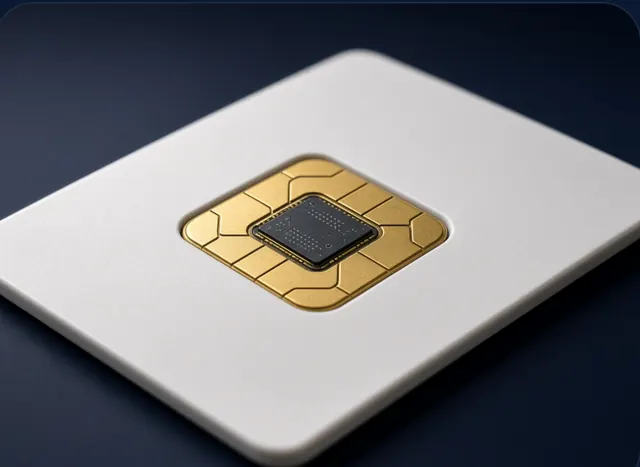
Fingerprint templates are saved on a secure element on the S-Badge. Matching executes physically isolated on the credential microchip within a cryptographic sandbox.
Security
Most Secure Fingerprint Technology
If it's not the LIVE Authorized Finger, it will not work.
Sub-dermal capacitive impedance sensing verifies biological pulse, micro-conductivity, and dermal heat prior to mathematical template correlation.
vpn_key PKI (Public Key Infrastructure) Authentication
- Serverless Deployment: No remote server dependencies, minimizing systemic breach vectors.
- Decentralized Credentials: Cryptographic token keys remain locked inside the local user card enclave.
- AES 128 or higher Encryption: FIPS-compliant cryptographic encapsulation for all card bus telemetry.
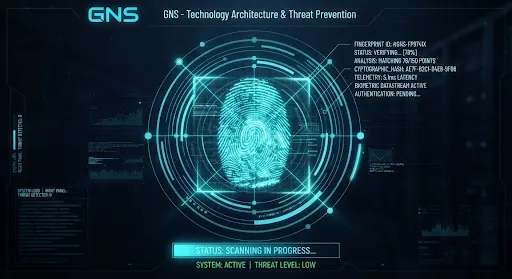
GNS Secure Browser will protect you against these attack methods
Air-gapped execution routines, runtime memory sanitization, and hardware-bound session isolation completely neutralize client endpoint exploitation techniques.
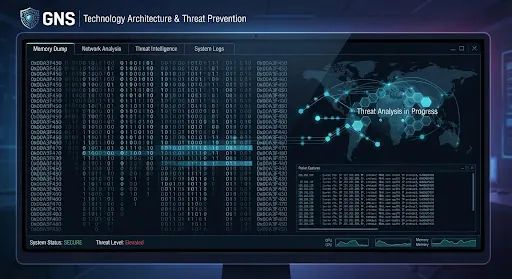
Memory Dumps
Threat Definition:"A file that captures/stores data stored in computer RAM"

Key Loggers
Threat Definition:"Captured data entered by the user such as usernames, passwords and other sensitive data"

Screen Shots
Threat Definition:"An image of what is currently displayed on a device screen containing credential data"
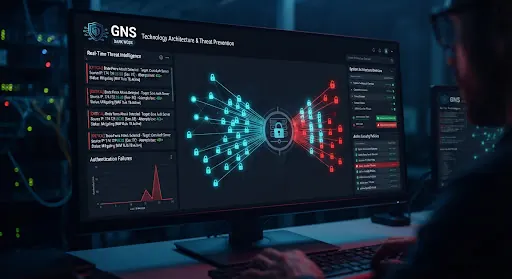
Brute Force Attacks
Threat Definition:"An attacker trying all combinations of usernames and passwords to gain access through trial and error"
Serverless Fingerprint Enrollment
How it Works
Complete standalone onboarding in under 30 seconds with zero IT administrator intervention and zero network credential exposure.
Step 1
The cardholder verifies identity by scanning a fingerprint on the S-Badge, 3 touches per finger. Up to 2 fingers allowed.
Step 2
The sensor creates an Algorithmic Image of the thumb which will be used for matching on the card.
Step 3
If there is a successful biometric match on the card, your Badge will be active. Otherwise, it will stay disabled in its default state.
Authentication systems configured for defense
Principle of least privilege
Users receive only the access required for core job functions.
Data encryption
AES 128/256 multi-layer encryption with a shared key generated per session.
Disable unused services
Authentication systems ship hardened — unused protocols stay off.
Enhanced logging
Motherboard ID, S-Badge IDs, PC name, IP address, Location (indoor / outdoor), Date and time of each request.
Disable unused auth protocols
Only the federated paths you approve remain reachable.
Works with the directory you already run
Active Directory CS
Active Directory integration includes RBAC, ABAC, automated randomized password management, virtualized desktop infrastructure (RDP), and X-Factor authentication. Least privilege combines ABAC and RBAC.
Centralized vs GNS Sovereign Biometrics
| Security Vector | Legacy Centralized Systems | GNS S-Badge Decentralized |
|---|---|---|
| Biometric Storage Location | Central Cloud / On-Prem SQL Server | Secure Element Microchip on Badge |
| Database Breach Exposure | Catastrophic System-Wide Theft Risk | Zero Database Breach Surface (None Exists) |
| Regulatory Burden (GDPR / BIPA) | High Compliance Cost & Legal Liability | Exempt: Mathematical Match-on-Card Only |
| Liveness Spoof Resistance | Optical only; vulnerable to latex casts | Capacitive Dermal Impedance Pulse Check |
| Enrollment Deployment Time | Requires IT technician + software portal | < 30 Seconds Standalone Serverless Flow |
Ready to deploy Sovereign On-Card Biometrics?
Request test credentials, verify technical whitepapers, or schedule a technical briefing with our systems architects.